
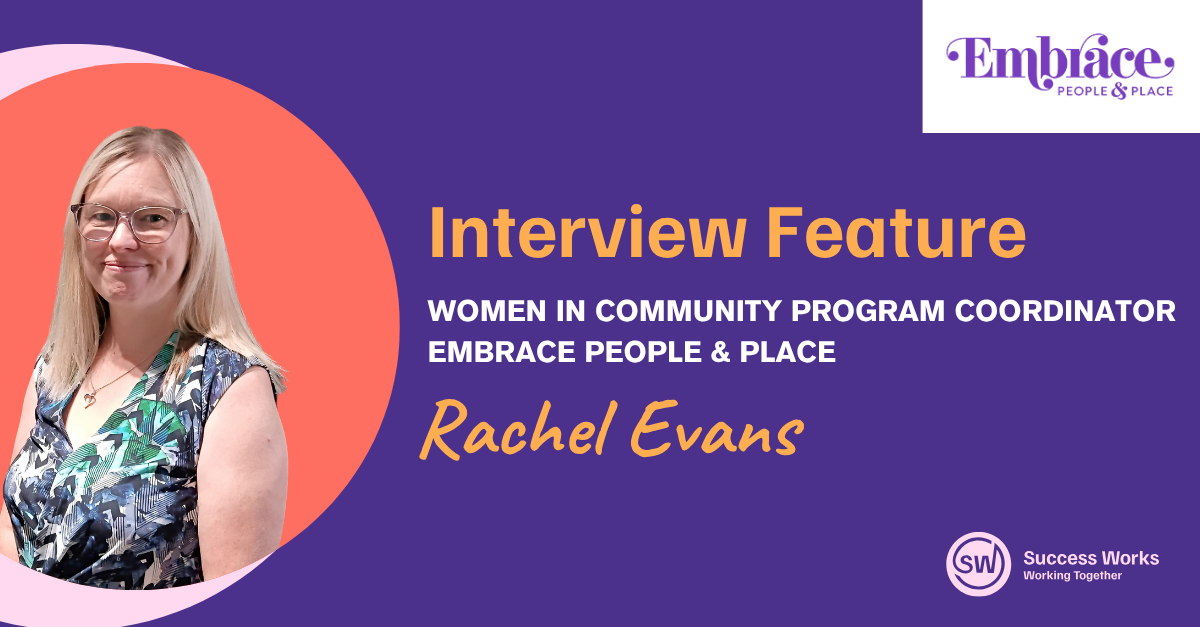
A Conversation with Rachel Evans from Embrace People & Place’s Women in Community Program.
At Success Works, we know that when women are given real opportunities, practical support and people who believe in them, lives change – and communities are stronger for it.
We’re always encouraged to see organisations working in ways that centre dignity, strengths and genuine pathways forward. Embrace People & Place’s Women in Community Program is one such initiative, taking an innovative, community-led approach to supporting women to build confidence, skills and meaningful employment connections.
We spoke with Rachel Evans, Women in Community Program Coordinator, about the program’s vision, its practical impact, and why collaborative, community-based approaches matter in creating lasting change.
Q: For readers who may be unfamiliar with the Women in Community Program, can you share what the program is and who it was designed to support?
Rachel: Absolutely. The Women in Community Program is really about walking alongside women as they transition back into the community after prison – not just helping them find a job or a house but supporting them to rebuild their lives in a way that feels right and meaningful for them. The program has two key stages. There’s the pre-release phase, where we spend about four months connecting with a woman while they are still inside – having conversations, building trust and starting to plan what life might look like when they come home. Then there is the post-release phase, which can last up to 22 months. That’s when our Women’s Advocates work closely with women on everything from housing to employment to health, family and wellbeing.
We don’t rush it – we go at the woman’s pace. Some days are about celebrating progress, and other days are about holding space through setbacks. Ultimately, it’s about building connection and confidence so that women step back into the community life, they feel capable, supported and in control.
Q. What barriers do the women you will be working alongside most commonly face when seeking employment or re-engaging with community?
Rachel: There are quite a few, and they often overlap. Many of the women we will be supporting will have experienced things like family violence, homelessness, loss of connection with children, or health and mental health challenges. On top of that, there is the stigma – having a criminal record can close doors before a woman even has a chance to show who she is. When you put all that together, it’s not hard to see why getting back into the workforce can feel out of reach. Even things that seem small, like getting an ID or arranging transport, can become big hurdles without the right support.
Q. Your program takes a strengths-based approach. Why is this so important when working with women who may have experienced significant disadvantage or system involvement?
Rachel: It’s absolutely crucial. A strengths-based approach shifts the focus from what’s wrong to what’s strong. Instead of seeing women as problems to fix, we see them as capable and resilient – women who have adapted and learned a lot through tough experiences. For women who have faced trauma or system involvement, recognising their own strengths can be life-changing. It rebuilds confidence, identity and hope. We help women see what they can do and the value they already bring.
In practice, that means looking at everyday skills – like caring for family, managing through challenges or supporting others – and showing how those experiences can translate into real strengths and skills for work.
Q. How will the Women in Community Program partner with local employers to create opportunities that are realistic, supportive and sustainable?
Rachel: Great question! We are really intentional about that. We don’t just send women out for jobs and hope for the best; we build genuine relationships with employers from the start. We sit down together and talk through what works, what doesn’t, and what sort of support both sides might need. Sometimes that might mean starting with shorter placements or flexible hours and gradually building confidence. We also provide training for employers around trauma-informed practice so they understand what might come up and how to create safe, inclusive workplaces.
We have a dedicated Employer Advocate who keeps the communication going – checking in with both the woman and the employer to make sure things are on track. That consistent support helps everyone adjust as needed. And because these partnerships are built on honesty and understanding, the results are sustainable – women stay in those jobs longer, and employers gain really committed, capable team members.
Q. What makes your approach different from more traditional employment programs?
Rachel: I would have to say the biggest difference is that we don’t see employment as the starting point – it’s part of a much bigger journey. So many programs focus narrowly on quick job placement. But if a woman doesn’t have stable housing, a sense of safety or someone to believe in her, then the job isn’t going to last.
Our program looks at the whole person – her environment, her health, her connections, her confidence – because they all feed into whether she can thrive in her work and her life. Advocates aren’t just checking boxes or filling forms; they are building relationships and staying with a woman through her journey, through the highs and the lows.
We also see employers as partners, not just recruiters. We co-design roles, talk about what sustainable support looks like, and make sure both the employers and the women feel prepared. It’s that balance between care and accountability that really sets the program apart. It’s about growing independence, not dependency – and doing it together, step by step.
Q. Looking ahead, what impact do you hope this program will have – not only for individual women, but for the broader community?
Rachel: Honestly, my hope is for women to feel proud again – proud of who they are and where they are headed. It’s about more than finding a job; it’s about safety, stability and a real sense of belonging. When a woman moves from surviving to thriving – reconnecting with family, secure housing and building a life she is proud of – the change is visible straight away. That change flows into the whole community. Neighbourhoods become safer, workplaces more inclusive, and families start to rebuild. That’s what matters to me most – women reclaiming their power, and communities seeing how much stronger we are when everyone is included.
Q. What role does community play in ensuring women are not defined by their past, but supported toward their future?
Rachel: Community is everything in this space. It’s where women return to, and it’s what can either welcome them home or push them back out. A supportive community can make the difference between someone moving forward or falling back into old patterns again. It starts with simple things – peer networks, having a space where you can connect without judgement, mentors who have walked a similar path. That genuine belonging helps rebuild trust and identity. Then there is the broader involvement – volunteering, joining local groups, being a part of something that matters. It gives women a sense of purpose and allows the community to see them for who they are now, not who they were.
When employers, neighbours and services get involved – when they say “you belong here” – that’s where real change happens. Communities that embrace inclusion don’t just help individual women; they actually become stronger and more cohesive themselves. It’s a win for everyone!
Q. For organisations or employers reading this, what would you say to them about becoming part of this kind of change?
Rachel: I’d say – please, give it a go. You might be surprised at how much your workplace gains. When an employer gives a woman leaving prison a chance, they aren’t just filling a job; they are helping to rebuild a life. The women we work with are strong, resourceful and determined. They have learnt to solve problems and adapt under pressure, which often makes them loyal and committed employees. Many employers tell us that having women with lived experience on their team brings empathy, creativity and a fresh perspective.




Comments are closed